Trustpilot alternatives for UK businesses: what to compare
We are one of the alternatives, so read this accordingly. What follows is the comparison we would want made if we were choosing.
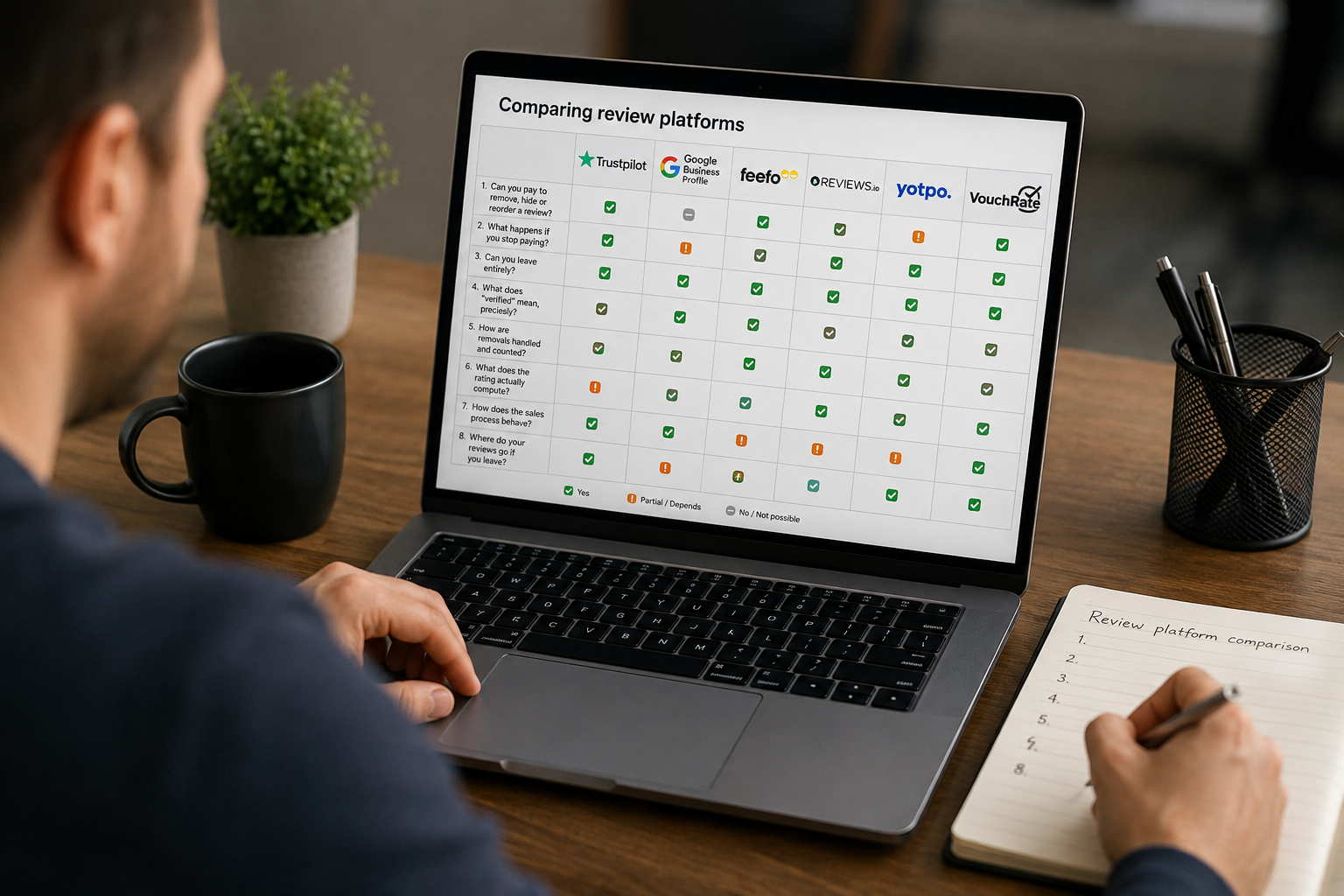
We are one of the alternatives, so treat this as interested. What follows is the comparison we would want someone to make if we were the ones choosing — including the parts where the answer is not us.
The realistic options
Trustpilot. The largest dedicated platform in this market by a wide margin, and the one most UK consumers recognise. Strong brand recognition means a Trustpilot rating carries weight with customers who would not have heard of a smaller platform. Free tier available; paid plans scale with size.
Google Business Profile. Free, unavoidable, and holds more local reviews than anywhere else. Not a replacement for a dedicated platform if you need invitation tooling or want reviews on your own site, but any local business should have it whatever else they do.
Feefo. Invitation-only collection, so every review is tied to a transaction. Strong verification story. More expensive, and the closed model means fewer reviews overall.
Reviews.io. Broad feature set, competitive pricing, widely used by ecommerce.
Yotpo / Okendo and similar. Built around Shopify and ecommerce more than reputation generally. Good if reviews are primarily product reviews on your own store.
Vouch Rate. Us. UK-focused, verification-led, everything about methodology and moderation published. Small and new, which is a real disadvantage — see below.
The eight questions
Ask these of every platform including this one. The answers matter more than the feature list.
1. Can you pay to remove, hide or reorder a review? The only question with one acceptable answer. Ask it directly and get it in writing.
2. What happens if you stop paying? Does your profile stay up with reviews intact? Can you still reply? A platform where cancelling means losing the ability to respond to criticism has built a retention mechanism out of your reputation.
3. Can you leave entirely? Can the profile be closed, or does it exist permanently whether you like it or not?
4. What does "verified" mean, precisely? Get the ladder. If it is not published, it means whatever is convenient.
5. How are removals handled and counted? Is there a published figure? An appeal route? Who decides?
6. What does the rating actually compute? A weighted average with undisclosed weights is not a measurement you can check.
7. How does the sales process behave? Ask existing customers, not the salesperson. Contract length, auto-renewal terms, notice period, and what happens when you try to cancel.
8. Where do your reviews go if you leave? Can you export them? Can they be displayed elsewhere? Reviews customers wrote about you should not be a hostage.
Our honest disadvantages
We are new. A Vouch Rate badge carries less recognition than a Trustpilot one, and will for some time. If your priority is a logo customers already trust, that is a real argument against us today.
We are small. Fewer integrations, fewer people, and the risks that come with any young company.
Fewer reviews in aggregate. Category pages are thin while the platform grows, so the discovery benefit of a large directory is not there yet.
Those are genuine reasons to choose something else, and we would rather say so than have you find out in month three.
What we do differently
Nothing about a profile is purchasable. No tier removes, reorders or hides anything. Businesses buy invitation tooling, widgets, an API and analytics.
Everything is published. The rating formula with its constants. The verification ladder with what each rung asserts. Removal totals. Reply behaviour, including whether a business answers only its supporters.
Claiming requires proving it is yours. Company number checked against Companies House, plus control of the domain. Typing a business name gets you nothing.
You can leave. Close the profile, take your data.
Monthly, no minimum term. £39, cancel whenever. We would rather keep customers because leaving is easy than because it is difficult.
The advice, honestly
If you are a local business with no reviews anywhere, start with Google. It is free, it is where people look, and nothing else moves the needle as much.
If you need invitation tooling and a rating on your own site, you need a dedicated platform. Compare on the eight questions rather than the feature grid, and weigh brand recognition seriously — it is worth real money and we do not have it yet.
If what you want is a rating whose method you can inspect and whose moderation you can check, that is the thing we built, and we would be glad to have you.